
When we say someone is a responsible person, we’re often referring to work. Showing up on time, completing tasks, being honest, owning up to mistakes. These values hold regardless of faith or lack thereof. Biblically speaking, being responsible means knowing what God expects and being actively responsible for fulfilling His expectations. As Paul wrote in Colossians 3:23, Whatever you do, work at it with all your heart, as working for the Lord, not for human masters… Easier said than done. We’re inclined to think about work in terms of worldly rewards—money, power, influence—working for ourselves or our bosses rather than for God.
Case in point. Last Friday evening, Keith and I had planned to watch a playback of an NFL football game. But with huge sums of money on the line, decision-makers seemed to be working for human masters and against God’s expectation of honest accountability. We decided there was nothing to be gained, nothing to learn by watching the spectacle, not this time.
For our discussion plus a delicious gumbo recipe, see my September 18th Friday Happy Hour post on Substack.
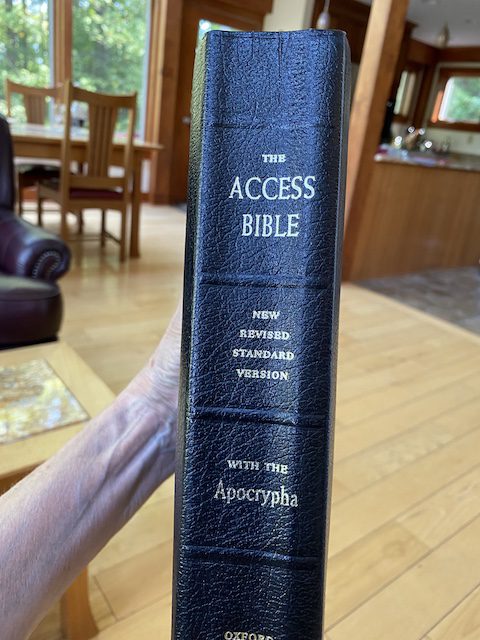
Responsible for our choices
So then, each of us will give an account of ourselves to God. Romans 14:12 NIV
We are responsible not only for work decisions but for all of our choices. Because, as Paul writes to the Romans, we will give account of ourselves to God. All of our life decisions, attitudes, and actions will be subject to divine examination. Ultimately, we will be judged.
The context of this verse contains another critical admonishment: don’t judge or you will be judged. That is, stop usurping God’s authority—precisely what Paul says at the beginning of this passage and in the verse following. This is helpful guidance for someone like me who hates to be criticized but all to easily stumbles into criticizing others. Paul elaborates on this topic in 1 Corinthians 4:1-5.
Being responsible for choices in biblical terms takes practice to become a habit. According to author Gretchen Rubin, in Better Than Before: Mastering the Habits of Our Everyday Lives, people have different tendencies with regard to habits and expectations. I am an Upholder, a rule-follower who likes to meet both outer and inner expectations. The three other tendencies are: Questioner (resists outer, meets inner), Obliger (meets outer, resists inner), and Rebel (resists both outer and inner expectations). Of course, the tendencies overlap; I question, oblige, and rebel, too. But as an Upholding rule-follower, I tend to take good advice. And the best advice of all is the Word of God.

Responsible for our families
Anyone who does not provide for their relatives, and especially for their own household, has denied the faith and is worse than an unbeliever. 1 Timothy 5:8 NIV
Everyone has a moral duty to take care of family members. For Christians, failing to do so would be contrary to the core of Christian faith: love your neighbor as yourself. The members of our households are our closest neighbors. Caring means providing for one’s immediate family’s basic needs—physical, emotional, spiritual—with special attention to children, grandchildren, widows and the aging. Unless unable due to hardship, Christians should not burden the church with the responsibility of providing for family members.
“…has denied the faith… worse than an unbeliever.” Harsh words from Paul. Even as an unbeliever, I understood responsibility to my husband, children, and parents. But the actions or inactions of believers who refuse to take care of their own contradict both parts of the new covenant: love God, love your neighbor. For a believer to knowingly break the faith is worse than unbelief, according to Paul. Interesting, huh?
In an age of broken families, where children grow up without a father or a mother and family members go “no contact,” the biblical call to be responsible might not be so simple. God does not ask us to put ourselves in harm’s way or accept dishonesty or abuse. “Guarding your heart isn’t selfish, it’s stewardship,” states Christian counselor Kris Reece.

Responsible for others
Carry each other’s burdens, and in this way you will fulfill the law of Christ. Galatians 6:2 NIV
Burdens—physical, emotional, spiritual—we all have them. As believers we’re meant to actively help, support, and care for one another. The heavy weight of grief, temptation, or distress cannot easily be borne alone. I am ever so grateful for my parents and siblings’ help during my hard times, and to my husband Keith, my constant encourager.
Fulfilling the “law of Christ” is to love one another as Jesus loved us. Being actively responsible here means abiding with others in their times of weakness. We live in community, helping, listening, and praying for one another.
Note that three verses later, Paul restates: “each one should carry their own load.” This takes us back to being responsible for the daily needs of our families and responsible for our choices. So, we have come full circle. Individual, family, community. A balance of personal responsibility.
Linkup with Five Minute Friday
On Fridays I send Friday Happy Hours: a recipe from our kitchen and a story about marriage in the third season of life. It is free, it arrives at the end of the week, and it gives a lighter touch to the experiences in this season. Come sit down with us – here.
Wisdom Builds Her House
In 2010 I left a 34-year career in education to build a mountain home with my husband. The literal house went up. Building the metaphorical one took longer. Four mysteries got in the way: my husband’s daughter, who I never met; who I was once I was neither teaching nor raising children; what really happened in 1957 when a man came to rob our house and hurt my mother; and how those things were connected. A memoir from Brandylane Publishers, in paperback, e-book, and audiobook. Find it here.


0 Comments