
The word criticize appears in Biblical passages dealing with judgment, slander, and interpersonal relationships. We humans are big on criticizing others, and I am no exception. Here’s an example.
Keith and I were settling into an evening of movie-watching when he said, “By the way, we’re out of peanuts, pistachios, chips and dip. We don’t eat them very often, but all we have for snacks is popcorn.”
“Urgh, why didn’t you tell me sooner?” I scolded. “I went to the grocery store yesterday.”
“I’m telling you now. Why are you always so critical?”
My hackles went up. “I’m not criticizing you.”
We lapsed into silence.

To criticize in our relationships
Don’t criticize, and then you won’t be criticized. Matthew 7:1 TLB
Matthew 7:1 warns against hypocrisy, self-righteousness, and judging others; it is a call for humility, self-reflection, and forgiveness. This verse does not mean that we should dismiss bad behavior. It’s more a warning about the “speck/log” issue, Jesus’ famous metaphor about our tendency to note flaws in others while ignoring our sins. We are called to deal with our issues first, to hold ourselves accountable for our “logs,” then respond to others’ “specks” with love.
The day after our spat, during my God time walk, I thought about what happened and remembered what Anne Lamott wrote about blame in Help, Thanks, Wow: The Three Essential Prayers. “I pray not to be such a whiny, self-obsessed baby, and give thanks that I am not quite as bad as I used to be (talk about miracles). Then something comes up, and I overreact and blame and sulk, and it feels like I haven’t made any progress at all. But it turns out I’m less of a brat than before, and I hit the reset button much sooner, shake it off, and get my sense of humor back. That we and those we love have lightened up over the years is one of the most astonishing sights we will ever witness.”
I had felt that I had fallen short for not having what Keith wanted on hand and defended myself by overreacting, putting the blame on him, and sulking—the log. I had criticized him for his speck. With this insight, I could hit the reset button.

To criticize our civil authorities
Let everyone be subject to the governing authorities, for there is no authority except that which God has established. Romans 13:1a NIV
In Romans 13:1, Paul states that as believers we are to submit to earthly governing authorities because they are established by God to maintain order and punish wrongdoing. As pastor Alistair Begg wrote in his June 7, 2026 blog, Vengeance is the Lord’s, “Christians are not to take justice into their own hands. Rather, we are to entrust the repayment of evil to the authorities God has put in place. Civil authorities are one example. When they fulfill their roles rightly, they serve as a terror to bad conduct but not to good. They are there to faithfully execute the rule of law and to punish those who violate it.”
Although we are required to respect civil law, there are limitations. We must obey God rather than human beings. Therefore, if we are commanded to commit a sin or prohibited from fulfilling God’s commands, we must disobey earthly authorities.
There are also limitations to civil disobedience. Begg: “You and I, then, are free to seek justice from the authorities that God has instituted to protect people and punish wrongdoing. Equally, we are free to turn the other cheek, resisting the all-too-natural urge to take matters into our own hands and enact our own vengeance.” Ultimately, judgment and justice will come.
To criticize what we don’t understand
But these people criticize things they don’t understand. They do understand some things. But they understand these things not by thinking, but by feeling, the way dumb animals understand things. And these are the things that destroy them. Jude 10 ERV
Jude 10—how apropos for our present-day, social media world: the arrogance of the ignorant who mock without thinking, who rely instead on physical, animalistic instincts. Judgment to the point of slander.
Writers sometimes experience this kind of criticism in online forums and critique groups. Here’s a fun, imaginary example of the former from Kim Lozano’s October 8, 2024 Brevity Blog post, In Which Herman Melville Seeks Critique in an Internet Forum—funny because it rings so true. She imagined Melville posting the first line of Moby Dick:
Hey, everyone. This is my first time posting and I’d appreciate your feedback. TIA! [Thanks in advance.] #firstlinefriday. “Call me Ishmael.”
Lozano: “Maybe someone would offer—and as scholars have noted—that by not actually saying his name is Ishmael, but simply asking the addressee to call him Ishmael, he’s launching with some curiosity-inducing ambiguity. But he’d also have to sort through:
It’s so short I really don’t have anything to go on.
It doesn’t grab me, sorry.
What’s it really telling us about the interiority of the main character?
If you’re tapping into something Biblical, many of your readers won’t get the reference.
Not bad but how about if you give us a little more, something like, ‘The first time I told her to call me Ishmael was the last time we ever spoke.’
Is the entire book going to be an address to the reader?
Who’s even speaking here?”
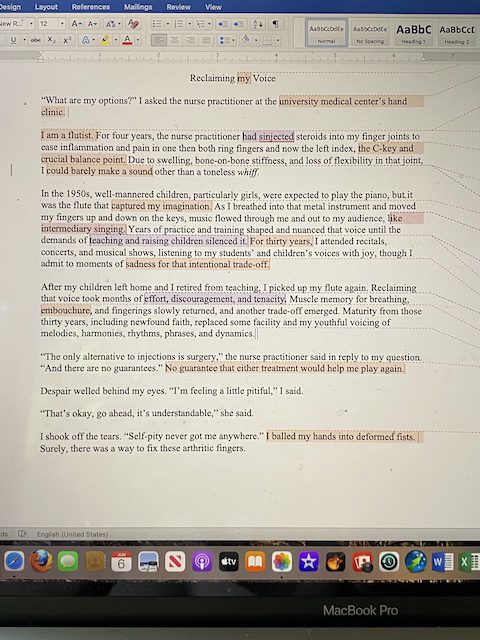
Criticism of one’s written work can be valid, as it was for me in early drafts of Wisdom Builds Her House. After several attempts and uncountable revisions, I slowly realized the braided narrative wasn’t working—what writing colleagues had told me all along. One major problem was that Gretchen was the more interesting character. Like Lucy Grealy in Anne Patchett’s memoir Truth and Beauty, Gretchen was the star, and I appeared in her shadow. Patchett and Grealy had been roommates and friends though; Gretchen had died twenty months before I met her father. Even with his permission, could I use her journals and his stories as Patchett used—and was criticized for using—excerpts from Grealy’s letters to her and private information she knew about Grealy’s sex life and addiction?
Criticism to think about instead of responding with feelings of anger or self-pity.
I’ve participated in an online critique group of savvy, professional writers for several years. The screen-shot earlier in the post shows a markup of one of my recent pieces. Feedback like this is gold.
Like the feedback my husband gave me. Like Paul’s guidance about submitting to civil authorities. Criticism as loving encouragement, for growth, in faith.
Linkup with Five Minute Friday.
Subscribe to Notes from Vanaprastha Podcasts on my YouTube Channel: https://www.youtube.com/@CaroleDuff
Subscribe to Notes from Vanaprastha: https://caroleduff.com
Follow me on Instagram: https://www.instagram.com/carole.duff2010/
Subscribe to my Friday Happy Hours Substack: https://substack.com/@caroleduff305076


Your sharing of a conversations about the shopping had a familiar ring to similar conversations in our house. I even took a photo of a plank but decided to go a different way in my post. You have it covered! I am your neighbour on FMF.
Love your take on the prompt! -C.D.
Carole, I appreciate how you share the realism of life’s interactions. As always, you bring the Word into the conversation. Blessings to you and Keith.
Thank you, Richard. Keeping it real with the Both/And of Word and actions. Blessings! -C.D.